Working with HDF#
While processing data, auxiliary data is required to understand the context of the data. This includes information about the data itself (e.g. units, data type, etc.) as well as information about the data generation (e.g. instrument settings, etc.). This information is often stored in separate files, however, for HDF5 files it is stored in attributes right next to the data. This is a powerful feature of HDF5 files. However, h5py only returns the data as numpy arrays. The attribute data needs to be read separately. Also, information about dimension scales is not returned to the user.
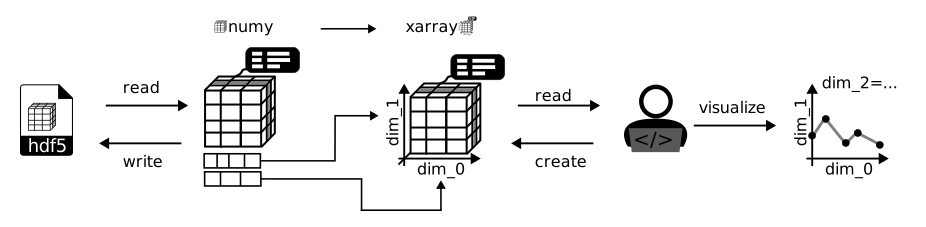
The h5rdmtoolbox makes use of xarray objects, which wrap a very similar concept around a numpy array, such that attributes and coordinates (respective concept to HDF dimension scales) are provided with the dataset values. The below figure illustrates the principle workflow. Before data is returned to the user, attributes and possibly related dimension scale data is retrieved to instantiate a xarray.DataArray object, which is returned to the user. With this, not only all information is grant to the user, but also very helpful features of the xarray library (e.g. plotting) are obtained.
All in all, the wrapper module aims to provide simple interfaces to HDF5 files to enhance data generation, processing, and analysis. The following sections will guide you through those steps.
Note
The package extends but does not limit the functionality of the h5py package. The syntax is also “h5py-like”. So, users that are familiar to the h5py package will find all features.