Database#
HDF5 can be considered a database itself, as it allows multiple datasets and their metadata (attributes) to be stored in a single file. Most of the time, you want to find records in an HDF5 file based on the attributes. However, the h5py package does not provide a function to do this.
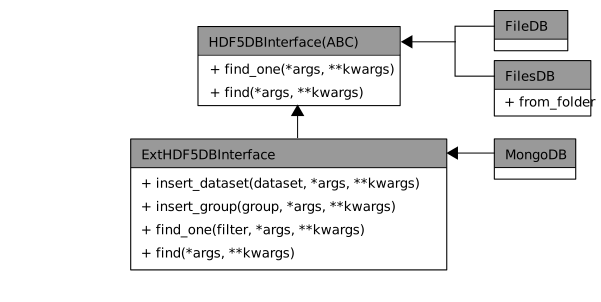
The h5rdmtoolbox provides interfaces to perform queries on a single or even multiple HDF5 files. Two approaches exist: Either a query is performed sequentially on one or multiple files or the file metadata is first written into a dedicated database solution. The first solution may be slow for many and/or large files, it is a convenient way without the need of third party databases. You can use it through FileDB (for querying a single HDF5 file) and FilesDB (for querying multiple files). Those classes inherit from the abstract class HDF5DBInterface.
To make use of the capabilities of dedicated databases (e.g. advanced queries and performant execution) implementations need to inherit from ExtHDF5DBInterface, which will require two more methods. As shown in the class diagram, one such concrete implementation is provided by the toolbox, which uses MongoDB as the dedicated database system.
The following two chapters show how the aforementioned approaches (using HDF5 itself and using monogDB) work:
FileDB: Allows to query inside a single file.MongoDB: Using pymongo (mongodb) to mirror metadata of HDF files into the database to be queried afterward.